
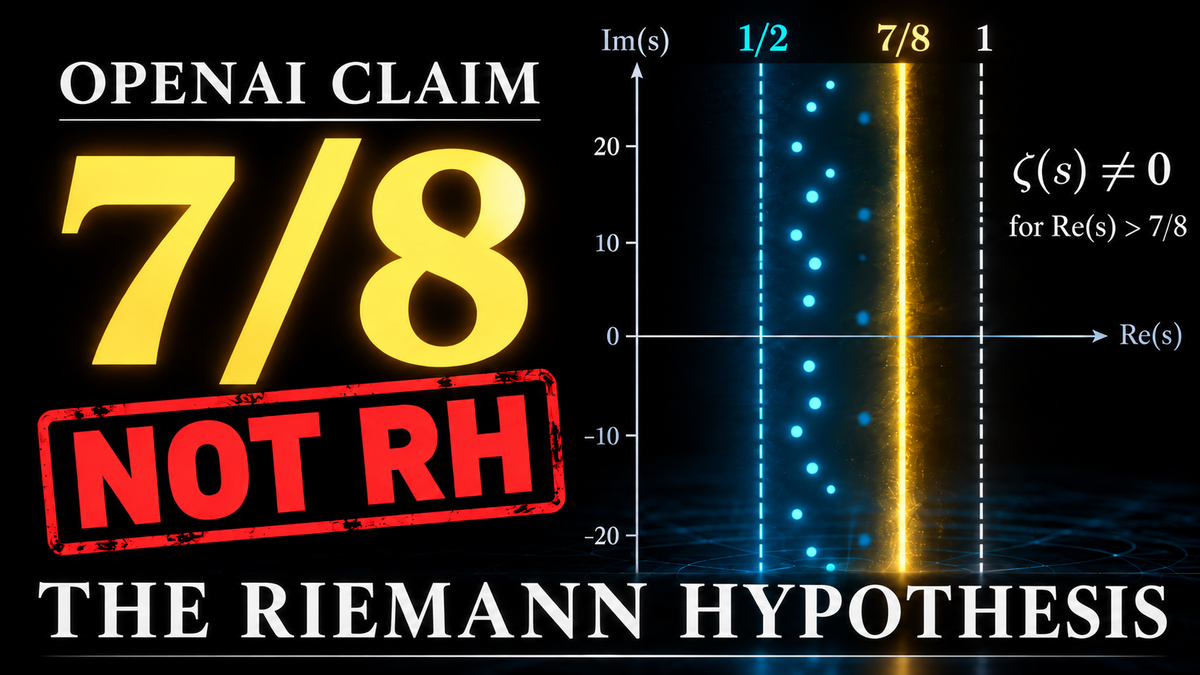
OpenAI Didn’t Solve the Riemann Hypothesis — So Why Is 7/8 Huge?

The Riemann Hypothesis remains unsolved. But buried inside OpenAI's October 2026 mathematics release is a claim that could still be historic.
One of the manuscripts, titled The Quasi-Riemann Hypothesis, claims to establish something mathematicians have pursued for more than a century: a fixed zero-free region for the Riemann zeta function.
The proposed boundary is 7/8.
That might sound underwhelming. After all, the Riemann Hypothesis predicts that every nontrivial zero lies exactly on the critical line at 1/2.
So why would proving that there are no zeros beyond 7/8 be such a big deal?
Because the remarkable part isn't how close 7/8 is to 1/2. It's that the boundary doesn't move.
Historically, unconditional zero-free regions near 1 have generally had boundaries that approach 1 as the imaginary part increases.
OpenAI's manuscript claims a fixed wall that remains in place no matter how high you go.
And the central statement comes with a Lean formalization: a machine-checkable mathematical proof of the encoded theorem.
If the result survives continued scrutiny, it could represent a major advance in analytic number theory.
🎥 I made a video explaining why this matters
In my latest Mathify video, I take a visual journey through the Riemann Hypothesis, the claimed 7/8 breakthrough, and the mathematics behind the proposed proof.
Watch: OpenAI Didn’t Solve the Riemann Hypothesis — So Why Is 7/8 Huge?
We explore why the zeros of the zeta function matter for understanding prime numbers, the difference between zero-density estimates and zero-free regions, and why the proof ventures into an unexpected mathematical world involving Eisenstein integers, cubic theta functions, Poisson summation, and large sieve estimates.
I also examine what Lean actually verifies, why two different bounds (11/12 and 7/8) appear in the manuscripts, and why describing this as a simple "three-hour AI proof" is misleading.
The real question isn't whether AI has solved the Riemann Hypothesis. It hasn't.
It's whether this claimed result has fundamentally changed what mathematicians can prove about the distribution of zeta zeros.
And what it might tell us about the future of mathematical discovery.
🎥 Watch the full animated explanation on YouTube:
🔒 Explore how these videos are made
This video was created using Mathify, my AI-powered platform for creating mathematical and scientific animations.
If you'd like to explore the production process behind Mathify's best-performing long-form videos, check out the Mathify Long-Form Source Vault.
It includes prompts, Mathify projects, MP4 scene exports, source code, scripts, and production workflows, with permanent access.
Explore the Mathify Long-Form Source Vault:
Or create your own mathematical animations with Mathify:
Further reading
- OpenAI — Sharing AI Progress in Mathematics
- The Quasi-Riemann Hypothesis — Original Manuscript
- Scope of the Lean Formalization
The claimed result remains subject to mathematical scrutiny. Formal verification of an encoded theorem does not by itself establish novelty, significance, or independent community acceptance.